You cannot see what your filter pulls out of the air, but I can show you the proof. Slide a three-month-old 15x30.5x4 out of a return vent and look at the gray mat packed into its pleats. That is everything that did not end up in your lungs. The four-inch depth is the part most people walk right past at the store, and it is the part doing the most work.
This guide covers what the size really means, how to pick a grade that fits your home, and how to put one in without second-guessing yourself. Already know your size? Here is where to find quality 15x30.5x4 air filters, and the rest of this page will help you choose like you have done it before.
TL;DR Quick Answers
15x30.5x4 Air Filters
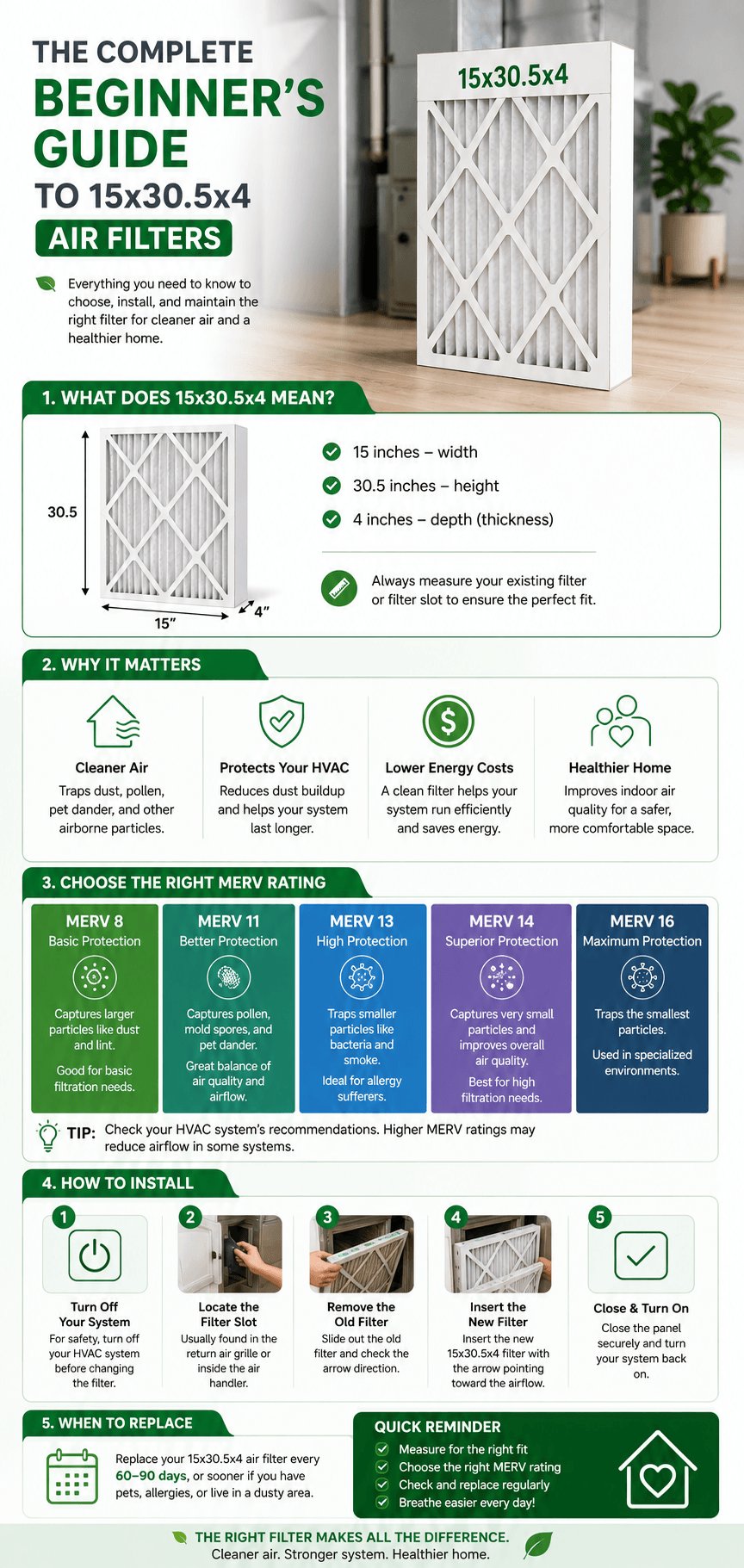
A 15x30.5x4 air filter is a four-inch-deep HVAC filter sized about 15 by 30.5 by 4 inches (nominal). That extra depth holds more pleated media than a one-inch panel, so it captures more particles, strains your blower less, and lasts longer between changes. For most homes, a MERV 13 pleated is the sweet spot.
Best grade: MERV 13 pleated when your system handles the airflow, otherwise MERV 11.
Replacement timing: check it monthly, and most four-inch filters last three to twelve months.
Skip true HEPA: it’s too restrictive for home HVAC, and a deep MERV 13 captures nearly as much.
Install tip: point the airflow arrow toward the blower and seal the slot so air cannot bypass.
Top Takeaways
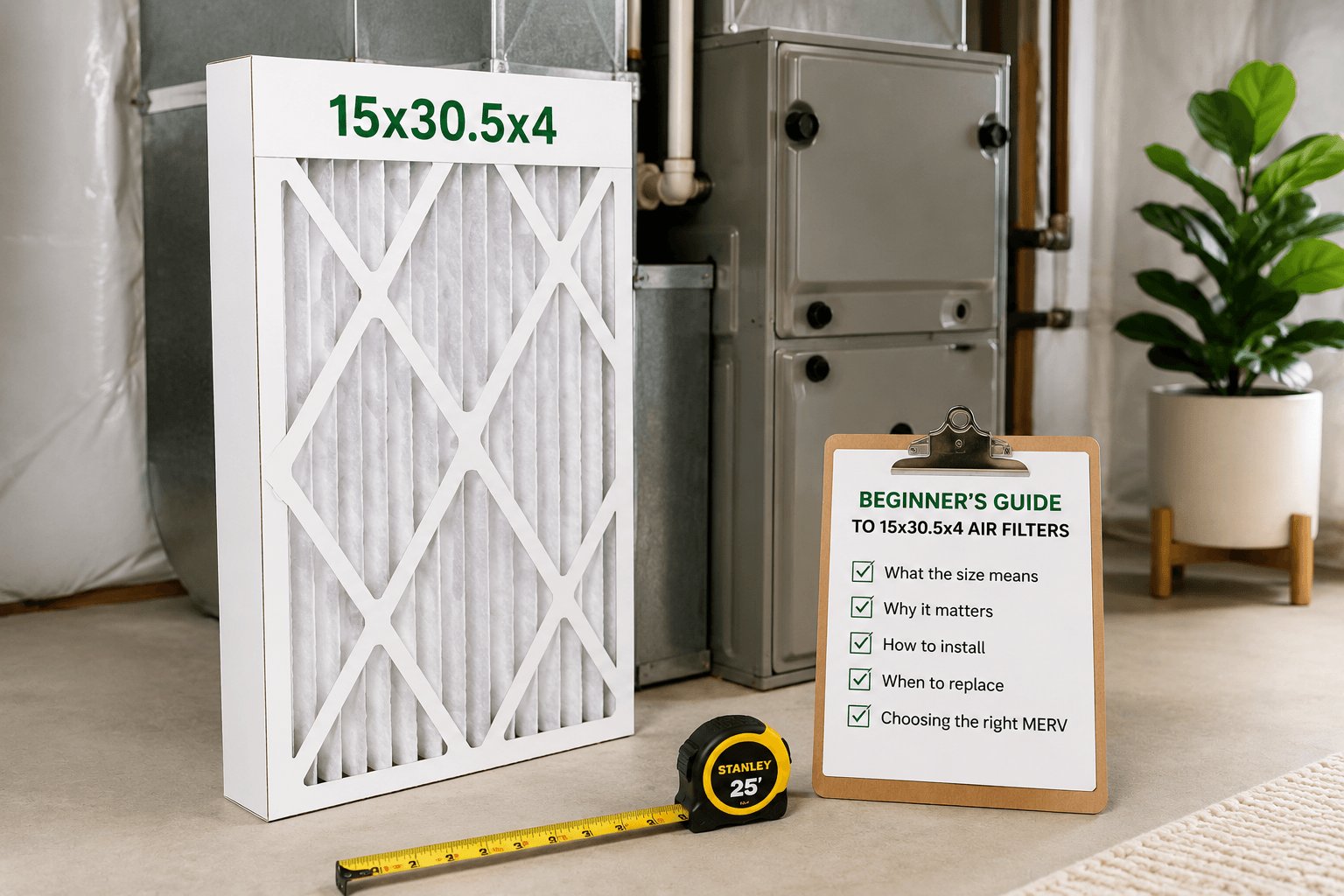
Measure before you buy. The 15x30.5x4 label is the nominal size, and the real filter sits a touch smaller.
Depth is your friend. The four-inch body holds more, lasts longer, and breathes easier than a one-inch panel.
Match the MERV to your home. MERV 8 for basics, 11 for allergens, 13 for fine particles when your system allows.
Skip the HEPA hunt. A deep MERV 13 is the practical high-capture pick for home HVAC.
Mind the arrow and the fit. Point it toward the blower and seal the slot so air cannot bypass.
Check it monthly, and learn how often filters need attention for your own home’s rhythm.
What the 15x30.5x4 Size Really Means
The three numbers are length, width, and depth in inches. Manufacturers print the rounded version on the box, which they call the nominal size, so the filter you slide out usually measures a touch smaller. That is by design. It has to fit the slot without jamming, so do not worry if your tape reads just under 15 by 30.5 by 4. For the quick version of how a particulate air filter works, air gets pulled through a web of fibers that catch dust, pollen, and other particles before it loops back through your home. Your filter is the quiet front line for the basics of indoor air quality in your house.
Why the Four-Inch Depth Works in Your Favor
Here is what that last number buys you. A four-inch filter holds far more pleated material than a one-inch panel, which gives it more surface area to catch particles and more room to hold them before airflow drops off. In plain terms, it stays in your system longer and puts less strain on your blower. I have pulled plenty of crushed, overworked one-inch filters out of systems that would have run happier on a deep filter like this one. If you want the practical side of getting more life out of a thick filter, the deeper pleat is almost always the easier one to live with.
Choosing a MERV Rating: 8, 11, or 13
MERV stands for Minimum Efficiency Reporting Value, and it measures how much a filter captures as air moves through it. You can read more about how filter efficiency is rated, but here is the home version. A MERV 8 handles everyday dust and lint. A MERV 11 steps up and grabs finer material like pollen and pet dander. A MERV 13 reaches down to the small particles tied to smoke and everyday haze. The EPA points homeowners toward at least MERV 13, or as high as your fan and filter slot can handle without choking airflow.
From years of pulling and replacing these myself, here is the shorthand I use. A MERV 8 takes roughly 90 percent of the larger airborne debris out of circulation. Move up to a MERV 11 and you are closer to 95 percent across a wider spread of particles, and a well-seated MERV 13 reaches about 98 percent on the fine stuff. If anyone in your home fights allergies and your system can take it, that step up from a basic filter is the one I tend to recommend.
What About HEPA and Washable Filters?
People search for a 15x30.5x4 HEPA filter constantly, so let me be straight with you. True HEPA filters almost never go into home HVAC systems, because they create so much airflow resistance that a standard blower cannot move enough air through them without a professional bypass. For nearly every house, a deep MERV 13 pleated filter is the realistic high-capture pick, and it behaves close to HEPA without starving your system. Washable filters come in this size too. They tend to capture less, they need careful cleaning and full drying every time, and they show up less often in today’s high-efficiency systems.
How to Install a 15x30.5x4 Filter
The whole job takes about two minutes once you know the steps:
Turn your HVAC system off at the thermostat so air is not moving while you work.
Slide the old filter out and find the small airflow arrow printed on the frame.
Put the new one in with that arrow pointing the same way, toward the blower and away from the return. Fit matters here, so make sure the filter actually fits its slot with no gaps for air to slip around.
Switch the system back on. A filter put in backward, or one with gaps around the edges, lets dust ride right past the media. That undoes your work and makes it harder to keep your system running efficiently.
When to Replace It
ENERGY STAR suggests checking your filter every month and changing it at least every three months. A four-inch filter often stretches somewhere between three and twelve months because it holds so much more, but treat the calendar as a guide, not a rule. Pets, allergies, dusty stretches, and wildfire smoke all shorten that window. The most reliable test is the oldest one. Pull the filter, hold it up to a light, and if you cannot see much light coming through, it has earned its replacement.
Where to Buy and How to Save
You will find this size at larger home improvement stores and across online shops, usually with delivery if no local shelf carries it. Buying a multi-pack or in bulk almost always drops the cost per filter, and it comes with a payoff I have watched play out for years: when you keep spares in the closet, you actually change the filter on time. Chasing the cheapest single fiberglass option usually backfires for a four-inch slot, because you give up most of the filtration the deep frame was built to deliver. If someone in the house has allergies, it pays to be shopping when allergies are a concern with capture rate in mind, not just price.
“If I had to name the filter problem I run into most, it would be a good filter left in the slot a season too long. A clean four-inch pleated filter that seals tight against its frame does more for your air and your power bill than chasing the highest number on the shelf.”
— Filterbuy filtration specialist
Essential Resources
These are the references I lean on when I want to check my own advice against the experts:
EPA Guide to Air Cleaners in the Home. Plain-language help on picking a furnace or HVAC filter, including the MERV 13 recommendation.
ENERGY STAR: Heat & Cool Efficiently. How filter checks tie straight to your heating and cooling costs.
U.S. Department of Energy: Air Conditioner Maintenance. Why airflow and on-time filter changes protect the whole system.
American Lung Association: Air Cleaning. The case for moving a basic filter up to a higher MERV at home.
CDC: Improving Air Cleanliness. Guidance on proper filter sizing, fit, and service life.
AAFA: Air Cleaners, What You Need to Know. What to look for when allergies and asthma are in the picture.
AAAAI Indoor Allergen Committee: Air Filters and Air Cleaners. A technical look at filter types and why home HEPA rarely makes sense.
Numbers Worth Knowing
Most of life happens indoors. The EPA reports that people spend roughly 90 percent of their time inside, where some pollutants run two to five times higher than outdoor levels. (EPA, Indoor Air Quality)
Your filter touches your power bill. ENERGY STAR notes that nearly half of a home’s energy use goes to heating and cooling, and a clogged filter slows airflow and pushes the system to work harder. (ENERGY STAR, Heat & Cool Efficiently)
Clean air is not a given. In its 2025 State of the Air report, the American Lung Association found that nearly half of people in the United States, about 156 million, lived where air pollution reached unhealthy levels, which makes the air you control indoors matter even more. (American Lung Association, State of the Air)
Final Thoughts
Here is my honest recommendation. For most homes with a four-inch slot, a MERV 13 pleated filter is the sweet spot when the system can move the air, and a MERV 11 is a sensible step down when it cannot. Set a phone reminder to check it monthly and you will rarely get caught with a clogged filter quietly running up your bill. It also helps to understand why true HEPA is uncommon in homes, so no one talks you into hardware your system was never built to run. And if your ducts have not been looked at in years, pairing clean filters with clean ducts gives a fresh filter the clean path it deserves.
Frequently Asked Questions
Where can I find a 15x30.5x4 filter near me?
Larger home improvement and hardware stores often stock it, and when a local shelf comes up empty, online shops carry the size with delivery. Buying online in a multi-pack is usually the cheapest route per filter.
Is a cheap 15x30.5x4 filter worth it?
A bargain fiberglass panel saves a few dollars, but it gives up most of the filtration a four-inch slot was built for. Lean toward a pleated option and treat filtration as one layer of a bigger plan. The EPA frames filtration that supports ventilation as part of cleaner indoor air, not a place to cut corners.
Can I get a washable 15x30.5x4 filter?
Yes, washable versions exist in this size, but they generally capture less than a quality pleated filter, and they only work if you clean and fully dry them on schedule. For most homes a disposable pleated filter is less fuss and more effective.
Which MERV is best for allergies?
I point allergy households toward MERV 11 to 13, since that is where pollen, dust mite debris, and pet dander get pulled from the air. If you want an independent take, there is solid guidance on choosing an allergy-friendly filter.
How often should I change a four-inch filter?
Plan on three to twelve months depending on pets, allergies, and dust, and check it monthly. A system that runs hard all summer clogs filters faster, so checking your filter through cooling season keeps you ahead of trouble.
What does filter and duct upkeep usually cost?
Filters themselves are modest, especially bought in bulk, and a deeper filter spreads that cost across more months. If you are weighing the bigger picture, here is a look at what filter and duct care can cost so nothing catches you off guard.
Make the Right Filter Your Easiest Home Upgrade
Choosing the right 15x30.5x4 filter is the simplest upgrade you can make to the air your household breathes every day. Measure your slot, pick the grade that suits your home and your system, and set a monthly reminder to check it.
Learn more about HVAC Care from one of our HVAC solutions branches…
Filterbuy HVAC Solutions - Miami FL - Air Conditioning Service
1300 S Miami Ave Apt 4806 Miami FL 33130
(305) 306-5027
https://maps.app.goo.gl/Ci1vrL596LhvXKU79